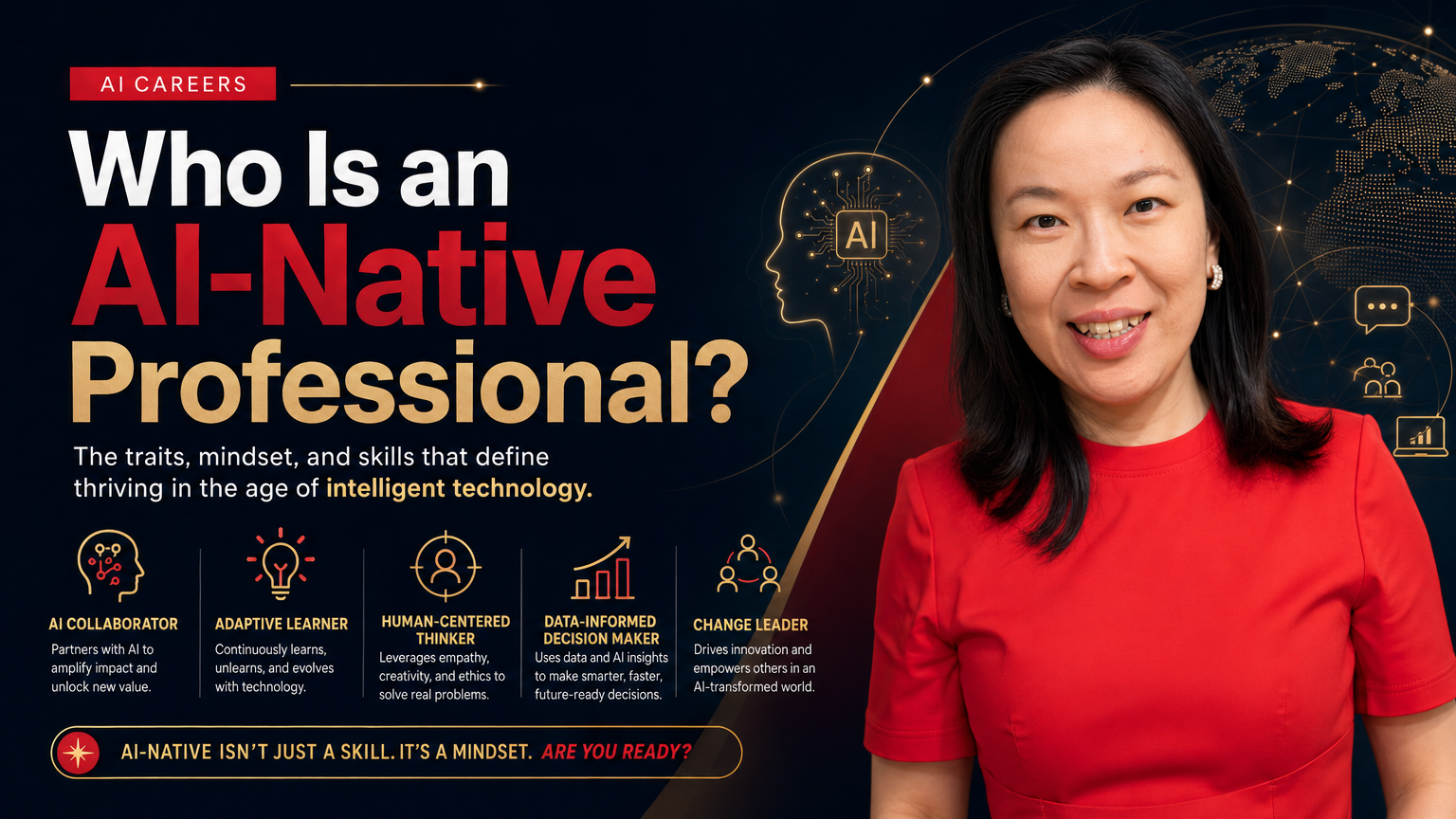
The Wrong Definition Is Everywhere
When most organisations in Singapore talk about becoming "AI-native," they mean one of two things: either everyone should know how to use ChatGPT, or the company should hire more people with data science backgrounds. Both of these definitions miss the point badly.
Knowing how to use ChatGPT is a starting point, not a destination. It is roughly equivalent to saying that a professional who can use Excel is a "spreadsheet-native" professional. The ability to open a tool and type something into it is not a meaningful capability benchmark.
Hiring more technical talent solves a different problem — and an important one — but does nothing for the 80% of your workforce who are non-technical knowledge workers doing document-heavy, communication-intensive, process-driven work that AI agents could substantially automate. They are not waiting for data scientists. They are waiting for training.
The Right Definition
An AI-native professional is someone who has integrated AI tools into the infrastructure of their work — not as an occasional aid they reach for when they remember, but as a reliable operational layer that runs beneath their day-to-day work consistently and automatically.
They have identified the highest-value automation opportunities in their role. They have built or configured tools that handle those automations reliably. They review AI outputs critically rather than accepting them uncritically. And they iterate — when a workflow is not performing as expected, they diagnose and improve it rather than abandoning it.
Most importantly: an AI-native professional has reclaimed the cognitive bandwidth that was previously consumed by process work and reinvested it in the work that actually requires their expertise. They are not faster at the same things. They are doing different things — better things — because the repetitive layer has been delegated.
What This Looks Like in Practice
An AI-native marketing manager does not sit down every Monday to compile her weekly performance report manually. The report was automated three months ago. She reviews it, adds her strategic interpretation, and sends it — in twelve minutes instead of ninety. She spends the time she recovered on the campaign thinking that the report was always supposed to inform.
An AI-native HR director does not spend two hours preparing for every performance review cycle by manually pulling data from four different systems. A workflow she built reads those systems, compiles the relevant data for each employee, and produces a pre-populated review template for each manager — ready for their qualitative input. She spends the time she recovered on the actual conversations with managers that determine whether performance cycles produce development or just paperwork.
An AI-native operations director does not produce his weekly report every Friday afternoon from scratch. The workflow he built reads his spreadsheets, runs the calculations, writes the narrative summary in his tone, and saves the formatted document to the shared drive. He reviews it and edits where needed — usually less than ten minutes of work. This is exactly what David's case study describes.
The Skills That Define an AI-Native Professional
Workflow thinking: The ability to look at a recurring task and see it as a sequence of discrete, specifiable steps that could be delegated to an agent. Most professionals can do their work intuitively — they have done it so many times that the process is automatic. An AI-native professional can also articulate that process explicitly enough to instruct an AI to do it.
Instruction precision: The ability to describe a task with enough specificity that an AI agent can execute it reliably. This is a learnable skill. It is the core of what we teach in Claude Cowork Training — not the tool itself, but the ability to use the tool well.
Critical output evaluation: The ability to review AI outputs with the professional judgment required to catch errors, identify misalignments with requirements, and improve quality through precise feedback. AI outputs are first drafts. AI-native professionals treat them as such — neither accepting them uncritically nor dismissing them because they are not perfect on the first attempt.
How to Develop AI-Native Professionals in Your Organisation
The path to AI-native professionals is not through awareness training — it is through hands-on, role-specific practice that builds the three skills above. Generic AI workshops create awareness. Structured, outcome-focused training creates capability.
The organisations in Singapore that are furthest ahead on this are not the ones that ran the most AI training sessions. They are the ones that ran fewer, more focused sessions — built around specific roles, with specific tools, producing specific outputs — and followed them up with structures that reinforced practice and shared wins.
To understand what that looks like in practice: Claude Cowork Workshop Singapore, AI Workshop for Teams Singapore, and Enterprise AI Training Singapore. Join our WhatsApp community for non-technical professionals building AI-native work habits in Singapore.
Start becoming AI-native this week
One workshop. One working workflow. The first step toward AI-native practice.
Book a workshop