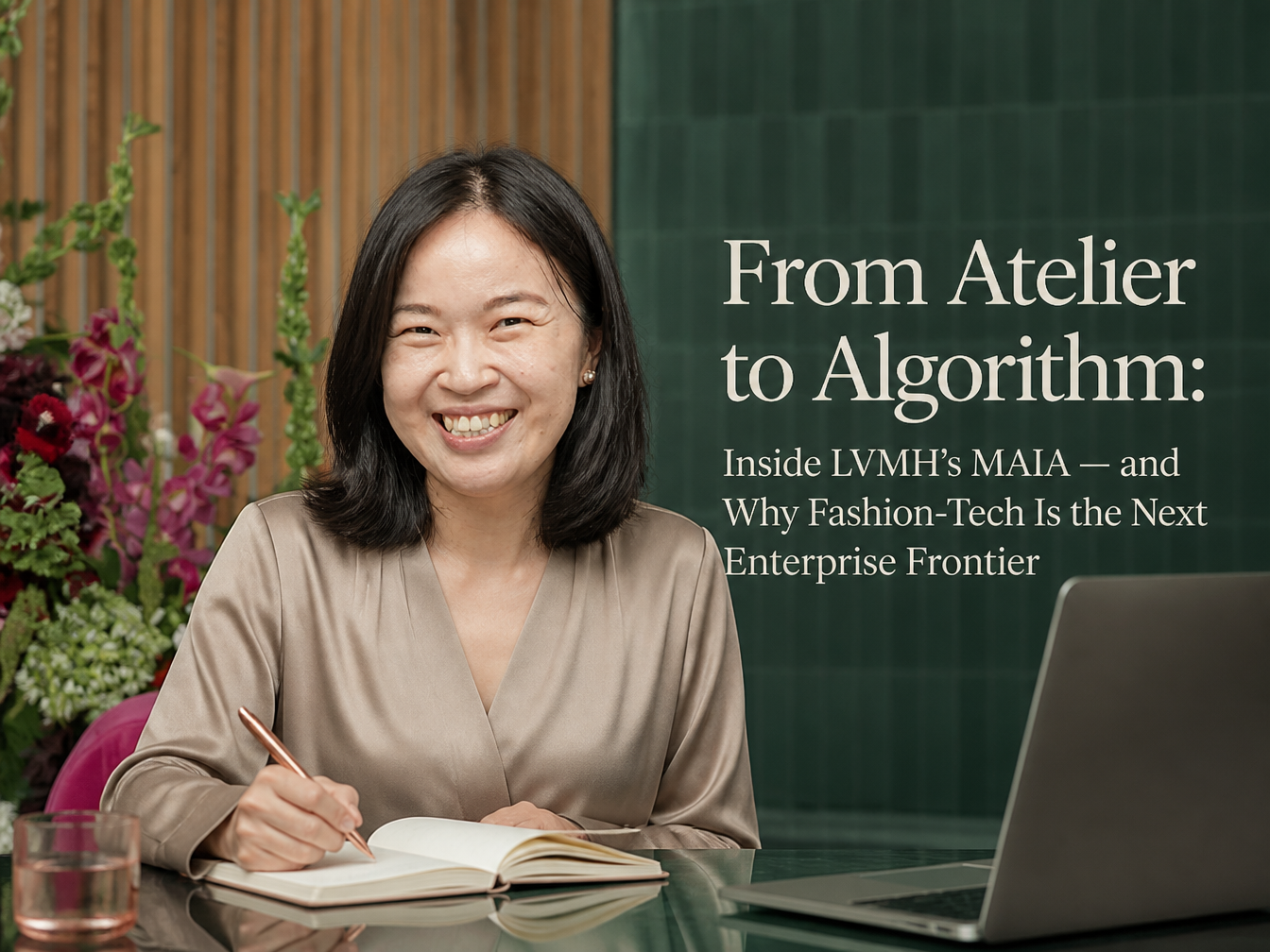
Luxury has always been the industry that pretends not to need technology. The atelier, the artisan, the hand-stitched seam — the whole story is built on the idea that human craft is the product. So when the world’s largest luxury group started rolling out AI at scale, it didn’t announce it the way a Silicon Valley company would. It just shipped it.
Meet MAIA — LVMH’s internal AI assistant, now answering more than two million queries a month across forty thousand employees and seventy-five Maisons, from Louis Vuitton and Dior to Tiffany, Sephora, and Moët Hennessy. It is, quietly, one of the most ambitious enterprise AI deployments on the planet. And it tells us something important about where fashion-tech is going next.
The Case Study: What LVMH Actually Built
MAIA isn’t a chatbot. It’s the connective tissue between dozens of brands that historically guarded their independence like state secrets. Here’s what makes the architecture interesting:
- A shared brain, with local autonomy. LVMH built a centralised “AI Factory” on Google Cloud, layering Gemini, Imagen and GPT models into a single internal platform. But each Maison still owns its own implementation, data and creative direction. It’s federation, not flattening.
- Real workflows, not demos. MAIA helps with marketing copy in 20+ languages, brief summarisation, competitive research, image generation for moodboards, retail training and customer-service triage. The use cases are mundane on purpose — that’s where the volume lives.
- Three strategic pillars. LVMH has been explicit about what AI is for: luxury customer experience, brand desirability and exemplary leadership. Notice what’s missing: “cost cutting.” That framing matters.
- Quiet tech for quiet luxury. MAIA doesn’t replace the artisan. It removes the friction around the artisan — the meetings, the translations, the asset hunts, the briefing cycles — so the human craft has more room to breathe.
Two million queries a month, by the way, is not a vanity metric. It’s the signal that AI has crossed from pilot to plumbing. Once a tool is plumbing, it stops being optional.
Why This Matters Beyond Luxury
Most enterprises looking at AI right now are stuck in a familiar trap: a few flashy pilots, a procurement battle, an “AI Centre of Excellence” that produces decks instead of deployments. LVMH’s MAIA is interesting because it sidesteps that pattern in three ways every enterprise can copy.
- 1. They built the dock before the boats. LVMH’s AI Factory is essentially a shared platform — identity, governance, model access, evaluation, prompt libraries — that any Maison can plug into. Individual brands don’t have to negotiate with model providers, hire ML engineers or solve PII compliance from scratch. The centre makes the edges fast. Most enterprises do the opposite: they let every business unit start from zero, and then wonder why nothing scales.
- 2. They didn’t pick a single model. MAIA routes across Gemini, Imagen and GPT depending on the task. Translation goes one place, image generation another, long-context summarisation a third. This is the un-sexy truth of enterprise AI: the right answer is almost never one foundation model. It’s a routing layer over many.
- 3. They made it boring on purpose. The most-used MAIA workflows are the ones that wouldn’t make a press release: cleaning up a brief, drafting a French-to-Japanese launch announcement, finding last season’s mood images. Boring is the win condition. If your AI strategy only shows up in keynotes and never in someone’s Tuesday, it isn’t a strategy yet.
If your AI strategy only shows up in keynotes and never in someone’s Tuesday, it isn’t a strategy yet.
Fashion-Tech Is the New Enterprise Frontier
For years, “fashion-tech” was code for try-on apps and resale marketplaces. That era is over. The frontier now is operational AI inside vertically integrated brand portfolios — and it’s where the most interesting enterprise work is happening. A few reasons this is going to keep accelerating:
- The data is finally rich enough. Decades of CRM, e-commerce, in-store telemetry, supply chain ERP and creative archives — sitting in silos until generative AI gave companies a reason to unify them.
- The margins justify the investment. A 1% lift in conversion at Dior is worth more than a 10% lift at most SaaS companies. Luxury can fund deep AI work that the rest of retail will inherit two years later.
- The brand risk forces discipline. When a single bad output can damage a 175-year-old Maison, you build evaluation, guardrails and human-in-the-loop review properly. That discipline is exactly what every regulated enterprise — banks, healthcare, law firms — actually needs.
- Creative and operational AI are converging. The same platform that drafts a Sephora email also moodboards a Loewe campaign also forecasts Tiffany inventory. The wall between “creative tools” and “enterprise tools” is dissolving, and luxury is where you can see it most clearly.
If you run an enterprise function — marketing, ops, customer experience, internal comms — fashion-tech is no longer a niche to ignore. It’s the canary. What LVMH ships in 2026 is what your CFO will ask about in 2027.
What to Take to Your Own Ship
Three questions worth asking your team this quarter, regardless of industry:
- Where’s our AI Factory? Not “do we have a strategy” — who owns the shared platform that makes every other team faster? If the answer is “nobody,” that’s the work.
- What are our two million queries? What’s the boring, high-volume internal workflow that, if AI handled it tomorrow, would free up hundreds of hours of human attention? Start there. Skip the moonshot.
- Are we measuring desirability, or just efficiency? LVMH’s framing — that AI exists to protect brand desirability — is the most underrated lesson in the whole rollout. Efficiency is table stakes. The companies that win the next decade will use AI to make their products more human, not less.
The Takeaway
LVMH didn’t deploy MAIA to chase a trend. They did it because the math of luxury — slowing growth, rising customer expectations, fragmented brand portfolios — made AI the only lever that could pull on all of it at once. Most enterprises are sitting on a version of that same math right now.
The good news: you don’t need 75 Maisons or a Google Cloud partnership to start. You need a clear platform, a few boring workflows and the discipline to make AI plumbing instead of theatre.
That’s the part we obsess over at ANCHR AI Labs. We help non-technical leaders — founders, operators, brand and marketing teams — chart their own AI rollout without needing an engineering org behind them. If LVMH’s MAIA is the supertanker, we help you launch the speedboat.
The next decade of enterprise won’t be won by who shouts loudest about AI. It’ll be won by who quietly weaves it into the seams.
AI for non-techies ⚓