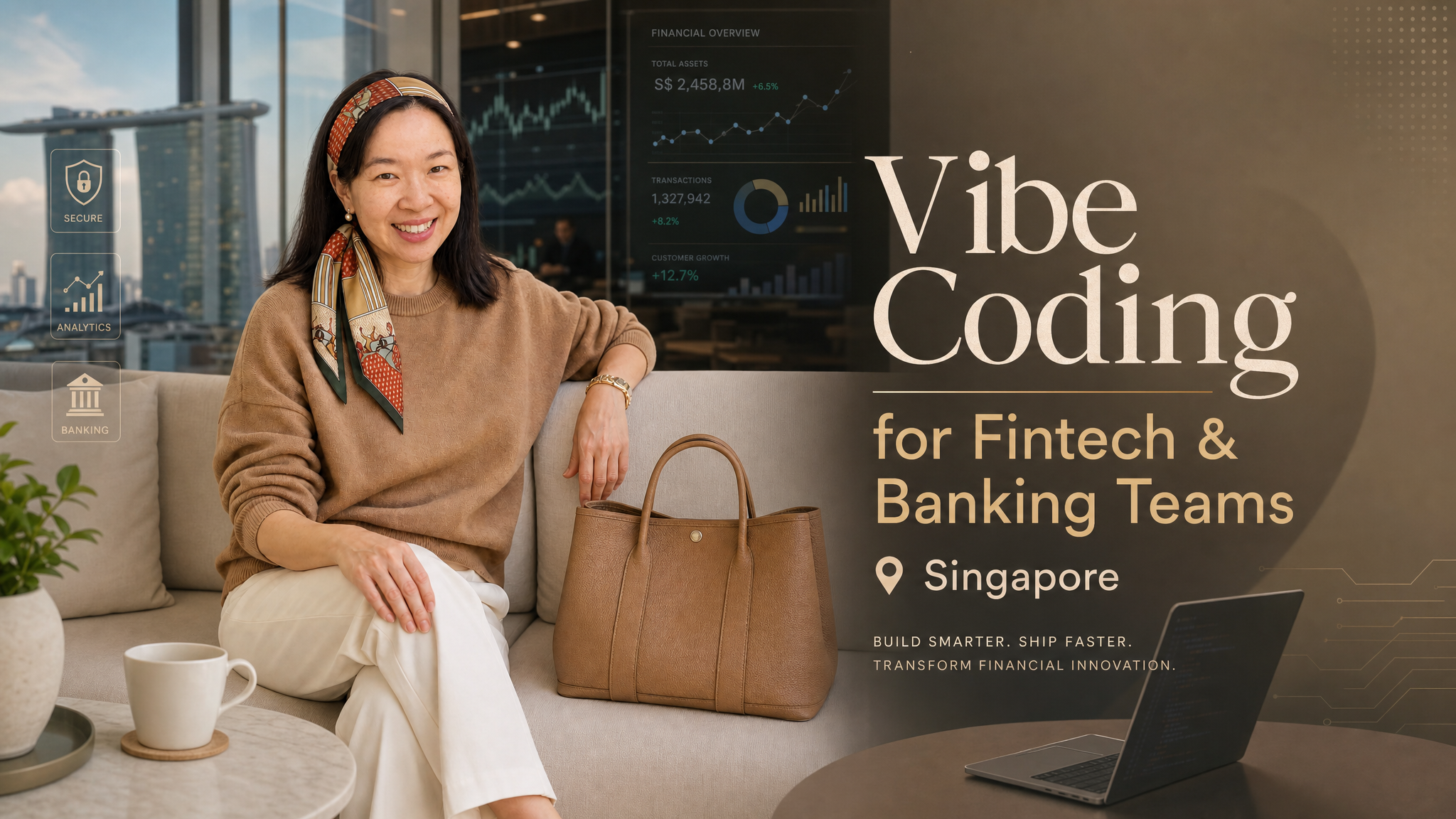
Banks move slowly. Ideas die waiting for IT tickets. Vibe coding changes that calculus — giving your team the ability to prototype, test, and validate without blocking the delivery queue.
Enquire About a Session →
The Problem
Here's a scenario that plays out constantly in Singapore's financial services sector: someone on the innovation team has a sharp idea for an internal tool. A dashboard that tracks deal flow differently. A report that takes four hours of manual Excel work and compresses it into minutes. A form that routes client requests to the right person automatically.
They write it up. They submit the IT ticket. They get told it'll be assessed in the next sprint planning cycle. Six months later, if they're lucky, something ships. Usually it's not quite what they meant, the requirements got lost in translation, and the team has moved on to a different problem anyway.
Vibe coding doesn't replace your IT team. It accelerates the path from idea to working prototype — so you can test whether something is worth building before it ever reaches an IT ticket. Your team builds the proof-of-concept. IT validates and scales it. The feedback loop gets tighter. Innovation actually happens.
The Singapore FinTech Association has already run a Vibe Coding x Fintech masterclass, which tells you this isn't a theoretical concept — it's something the industry is actively adopting. The question is whether your team is ahead of that curve or catching up to it.
What Gets Built
Everything built in the session is proof-of-concept first — designed to validate ideas and demonstrate feasibility, not to go into production directly. Here's what teams typically build:
None of these require access to production systems. They work with sample data, exported files, or test environments. The goal at this stage is to prove the concept works — not to ship to clients.
Who Attends
This workshop works best when it's attended by the people who are closest to the problems — not just the people who manage them. That usually means:
You're tasked with making change happen. Vibe coding gives you a way to show stakeholders a working prototype instead of a slide deck. Faster buy-in, faster iteration.
PMs and business analysts who sit between the business and tech. Being able to prototype ideas independently means cleaner briefs and fewer miscommunications with engineering.
Self-serve tools built by RMs, for RMs. Automate the parts of your client reporting and prep work that don't need to go through central systems.
The teams who live in spreadsheets and manual processes. The ROI on automation is highest here — and the problems are well-defined enough that vibe coding is very effective.
We also run sessions for finance teams specifically using Claude Cowork — a structured AI workflow designed for non-technical financial professionals.
Compliance & Risk
We know compliance is not an afterthought in financial services — it's a load-bearing wall. Here's how we approach it:
We've run workshops for teams at Singapore banking institutions and understand the environment. This isn't us trying to sneak AI past your risk team — it's us helping your people do more with the tools they already have access to.
Trust Signals
ANCHR AI Labs has delivered AI training for teams across Singapore's banking and financial services sector. We're trusted by institutions that take compliance seriously — because we take it seriously too.
The trainer, Wan Wei, has presented at industry events including sessions affiliated with the Singapore FinTech Association. She understands that fintech teams aren't looking for a Silicon Valley-style "move fast and break things" workshop — they're looking for practical capability they can apply within the guardrails that already exist.
If you'd like to understand how we've structured programmes for other finance teams, get in touch. We're happy to share details under NDA.
We also run a dedicated programme for finance professionals using Claude — see the Claude Cowork for Finance Teams training page for details.
Related Training
Tell us about your team, your context, and what you're trying to prototype. We'll design a session around your constraints — including your compliance ones.
💬 Message Us on WhatsAppFAQ
Do we need to share real client data in the workshop?
Never. All workshop exercises use synthetic or anonymised datasets. We design the session so that real client or proprietary data is never required — and we make that explicit to participants upfront. If your team wants to work on a problem that involves sensitive data, we'll help you create a clean, representative proxy dataset before the session.
Is this appropriate for a regulated environment?
Yes, with the right framing. The workshop is explicitly scoped to proof-of-concept prototyping, not production deployment. We work within your approved tooling, handle no sensitive data, and can brief your risk or compliance function in advance if needed. We've run sessions for teams at Singapore financial institutions — this isn't unfamiliar territory for us.
What's the typical team size for a session?
We cap standard sessions at 20 participants to maintain quality and ensure everyone gets individual attention during the build phase. For larger teams, we can run parallel cohorts. Innovation sprints and leadership sessions typically work best with 8–12 people — small enough that the discussion is substantive.
Can we run this in-house at our bank or office?
Yes — in-house is actually our preferred format for finance teams, since it lets participants work on problems that are real to their environment. We just need a room with good internet, individual laptops, and a projector. We handle everything else, including pre-session setup and a post-session resources pack your team can refer back to.